
How to Buy a Steel Building on GeM: LGSF and Steel Structure Buildings — 2026 Guide for Government Buyers
The short answer
Yes, you can buy a complete steel building on GeM. If it is a simple LGSF office block, GeM already has a catalogue category for it. If it is a school, health centre, fire station, hall or godown, you will almost always publish a custom bid or a BOQ bid instead. And since nearly every building costs more than Rs 10 lakh, expect to run a bid or reverse auction rather than buy directly.
Last reviewed: 23 November 2026
The call usually goes like this. An engineer has a sanctioned building, a budget that has to be used before the financial year closes, and an instruction to buy through GeM. He has bought furniture, printers and air conditioners on the portal many times. A building is new territory, and nobody in the office wants to be the one who gets the procedure wrong.
This guide is written for that engineer, the procurement officer working with him, and the architect who may be advising them both. We manufacture and erect steel buildings ourselves from our factory in Howrah, so what follows is the supplier's view of what makes a GeM building purchase go smoothly — and what makes it stall.
First, Decide Which Kind of Steel Building You Need
Before you think about GeM at all, settle one question: does your building need rooms, or does it need open span? The answer decides the type of steel building, and the type decides which suppliers can bid.
There are two main types. LGSF (light gauge steel framing) uses many thin, galvanised steel studs and joists that together form load-bearing walls and floors. It is ideal for buildings made of rooms. A steel structure building uses a heavier frame of steel columns and beams, which lets it cover wide spaces with no columns in the middle. Both are steel buildings, both are made in a factory and assembled on site, but they are not interchangeable.
| LGSF building | Steel structure building | |
|---|---|---|
| How the frame works | Closely spaced thin steel studs and joists carry the load together | A few heavy columns and beams carry the load |
| Room sizes and spans | Rooms of roughly 4 to 8 metres | Column-free spaces of 30 metres and more |
| Height | Usually up to ground plus three | Single-storey halls to multi-storey blocks |
| Walls | Insulated cavity walls are part of the frame | Cladding or LGSF walls are fixed to the frame |
| Typical government uses | Offices, schools, anganwadis, health centres, hostels, staff quarters, site offices | Fire stations, halls, auditoriums, godowns, workshops, vehicle sheds |
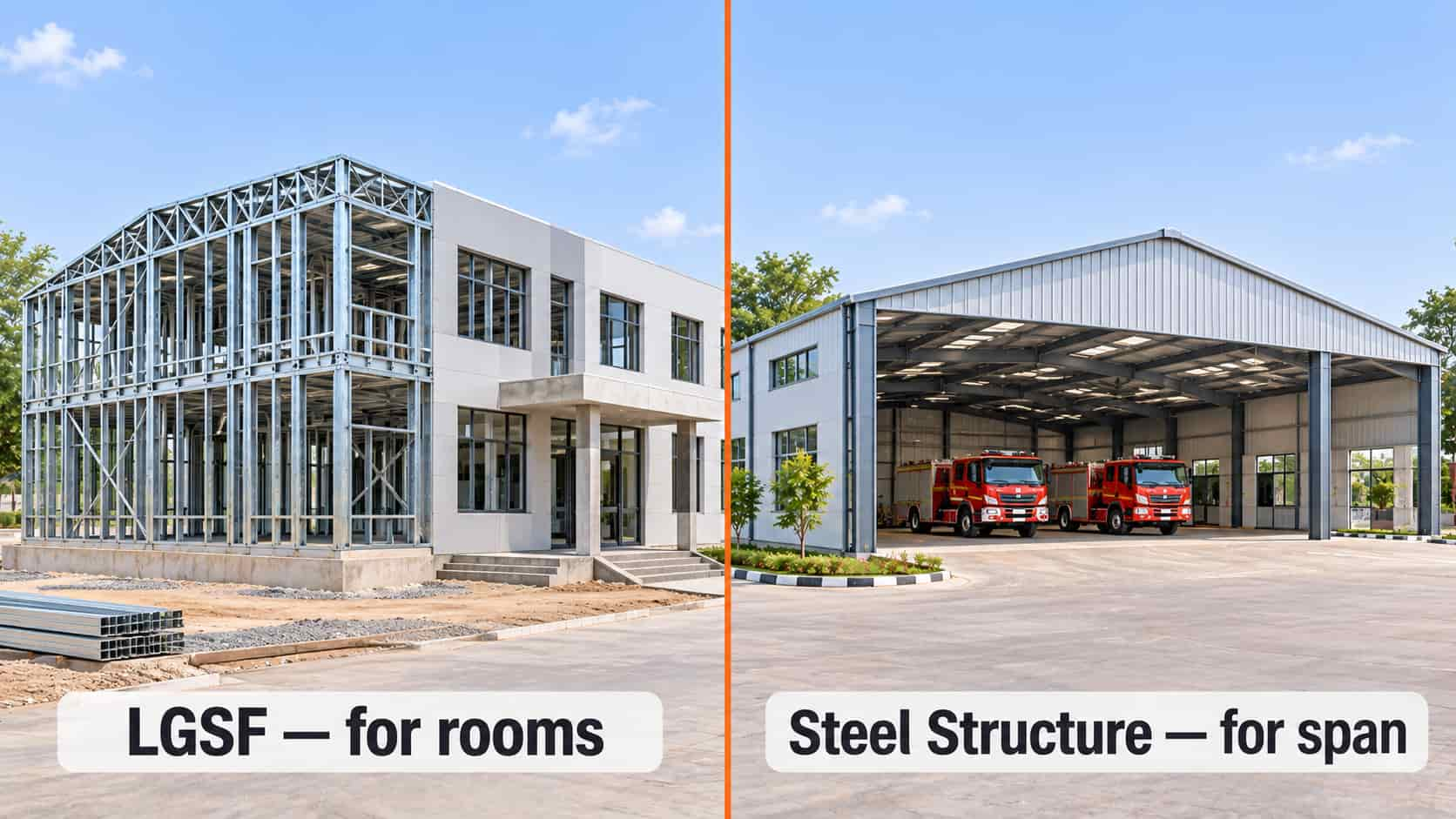
Plenty of institutional buildings use both. A multi-storey block, for example, might have a steel structure frame for strength and span, with LGSF walls giving it insulated, finished rooms. If you want to go deeper, our guide to the types of steel buildings in India compares every system side by side.
The Three Ways to Buy a Building on GeM
GeM gives you three routes. Which one you use depends on how closely your building matches something already listed on the portal.
| What you are buying | Type of steel building | Usual GeM route |
|---|---|---|
| Porta cabin, prefab hut, guard room | Light prefab cabin | Catalogue item, if a listed product fits |
| Simple one or two-storey office block | LGSF | LGSF super structure category |
| School, anganwadi, health centre, hostel, quarters | LGSF | Custom bid |
| Site office, labour camp, isolation centre | LGSF | Catalogue item or custom bid |
| Fire station, workshop, vehicle shed | Steel structure | Custom bid or BOQ bid |
| Hall, auditorium, indoor sports hall | Steel structure | Custom bid or BOQ bid |
| Godown or warehouse | Steel structure | Custom bid or BOQ bid |
| Multi-storey office or institutional block | Steel structure frame with LGSF walls | Custom bid or BOQ bid |
One habit worth building: search the portal for your item before choosing a route. GeM keeps adding categories, and if a suitable one exists you are generally expected to use it.
GeM Purchase Limits: Why Almost Every Building Goes to Bid
The value of the purchase decides how you are allowed to buy. The Ministry of Finance revised the GeM limits for goods under the General Financial Rules on 10 July 2024:
| Value | Buying mode | Relevance for buildings |
|---|---|---|
| Up to Rs 50,000 | Direct purchase from any available seller | None |
| Rs 50,000 to Rs 10 lakh | L1 purchase: lowest price among at least three manufacturers | A small cabin at most |
| Above Rs 10 lakh | Bid or reverse auction | Practically every building |
Some ministries, institutions and states work with their own limits, and a few allow higher direct purchases. Your purchase manual has the final word.
The GeM LGSF Super Structure Category
If you need a straightforward office or administrative block, start here. GeM lists a category for a factory-finished, custom-designed light gauge steel framed super structure for office buildings. The supplier designs, supplies, installs, tests and commissions it.
Read the terms closely, because a few of them shape your whole project:
- The price is all-inclusive: concept and detailed design, fabrication, transport, installation and free delivery to your site.
- The structural stability report is examined by an NIT or IIT, and that cost sits inside the price.
- Payment comes in two parts: 80% after delivery, 20% after installation and commissioning.
- You, the consignee, build the foundation to the seller's drawings.
- Erection must finish within 90 days of you confirming the foundation is ready.
When you select the product, you fill in its size, clear height, floors, rooms and toilets per floor, doors and windows, your site's wind speed and seismic zone, the temperature range and the warranty period.
GeM also marks LGSF as a new-technology product and asks buyers to judge its suitability and price carefully. That is sensible advice, and easy to act on: ask every bidder for completed government projects, test reports and their stability report. Serious manufacturers will have all three ready.
Not sure which route fits your building?
Send us the building's use, a plan or rough sketch, the built-up area and the location. We will tell you whether it suits LGSF or a steel structure, and whether the catalogue category fits or you need a custom bid. No charge, and we reply within 2 working days.
Custom Bid: The Route Most Buildings Take
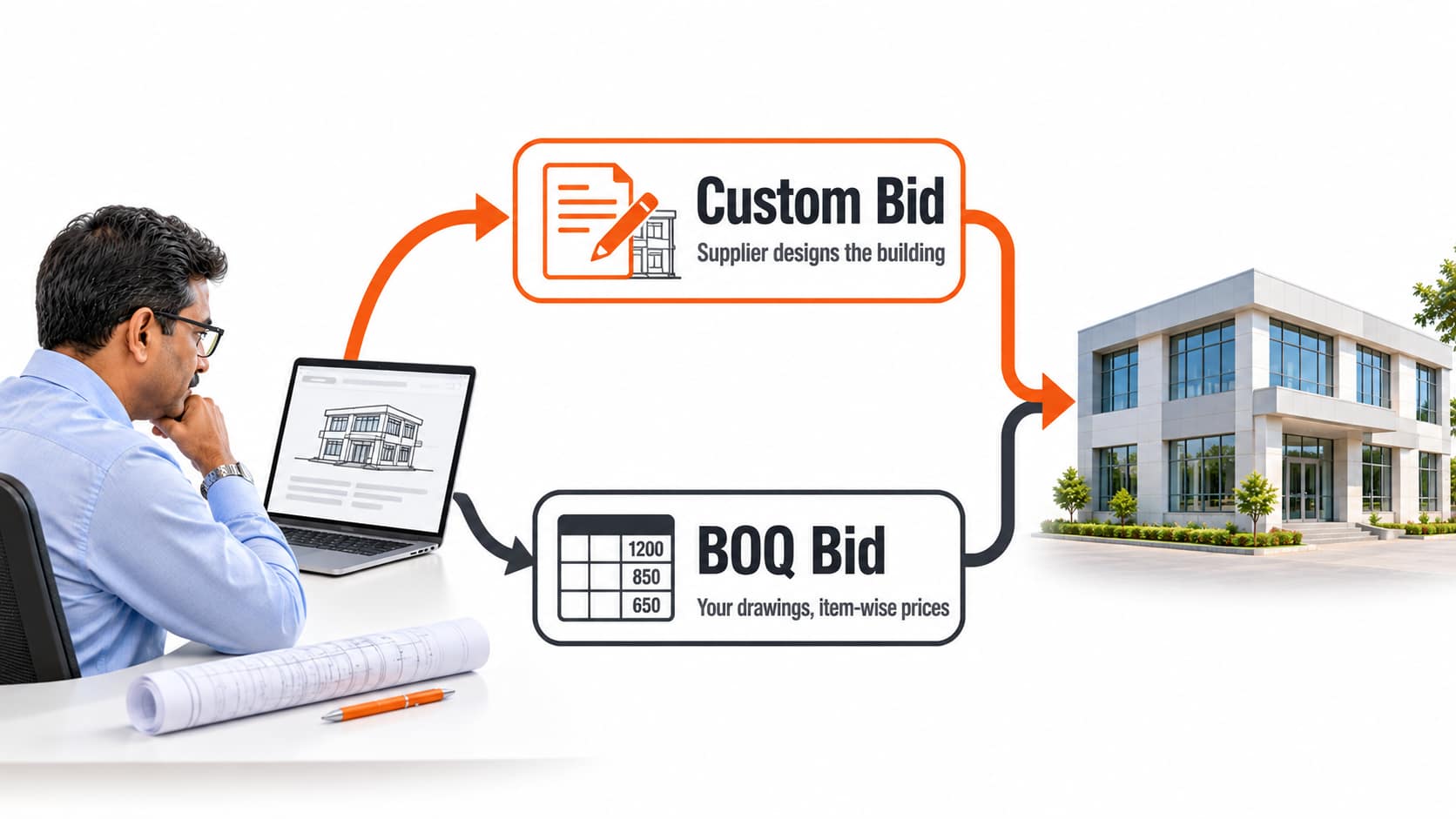
Schools, health centres, fire stations, halls and godowns rarely match a catalogue listing. Each has its own layout, span or finish. For these, GeM lets you describe the item yourself through a custom bid. The rules are straightforward:
- Generate a GeM Availability Report first. It records that no catalogue item meets your need.
- The estimated value must be above Rs 5 lakh, and you give an undertaking that existing catalogues cannot meet the requirement.
- Keep the bid open for 10 to 45 days. Anything under 21 days needs your competent authority's approval.
The real skill is in how you write it. If the supplier is going to design the structure, describe what the building must do rather than how to build it: its use, its loads, its site conditions and everything that must be included. Each bidder can then propose the right LGSF or steel structure design, and you still control the result.
BOQ Bid: When You Already Have Drawings
A BOQ bid makes sense when a consultant has already designed the building and worked out the quantities. Bidders price every line — structural steel, walls, roofing, doors and windows, electrical, plumbing — and you can evaluate by total value, item by item or by group. GeM offers these evaluation options for BOQ bids estimated at Rs 5 lakh and above.
The catch is that a BOQ assumes the quantities are fixed. If you want the supplier to design the structure, a custom bid is usually the cleaner choice.
The Process, Start to Finish
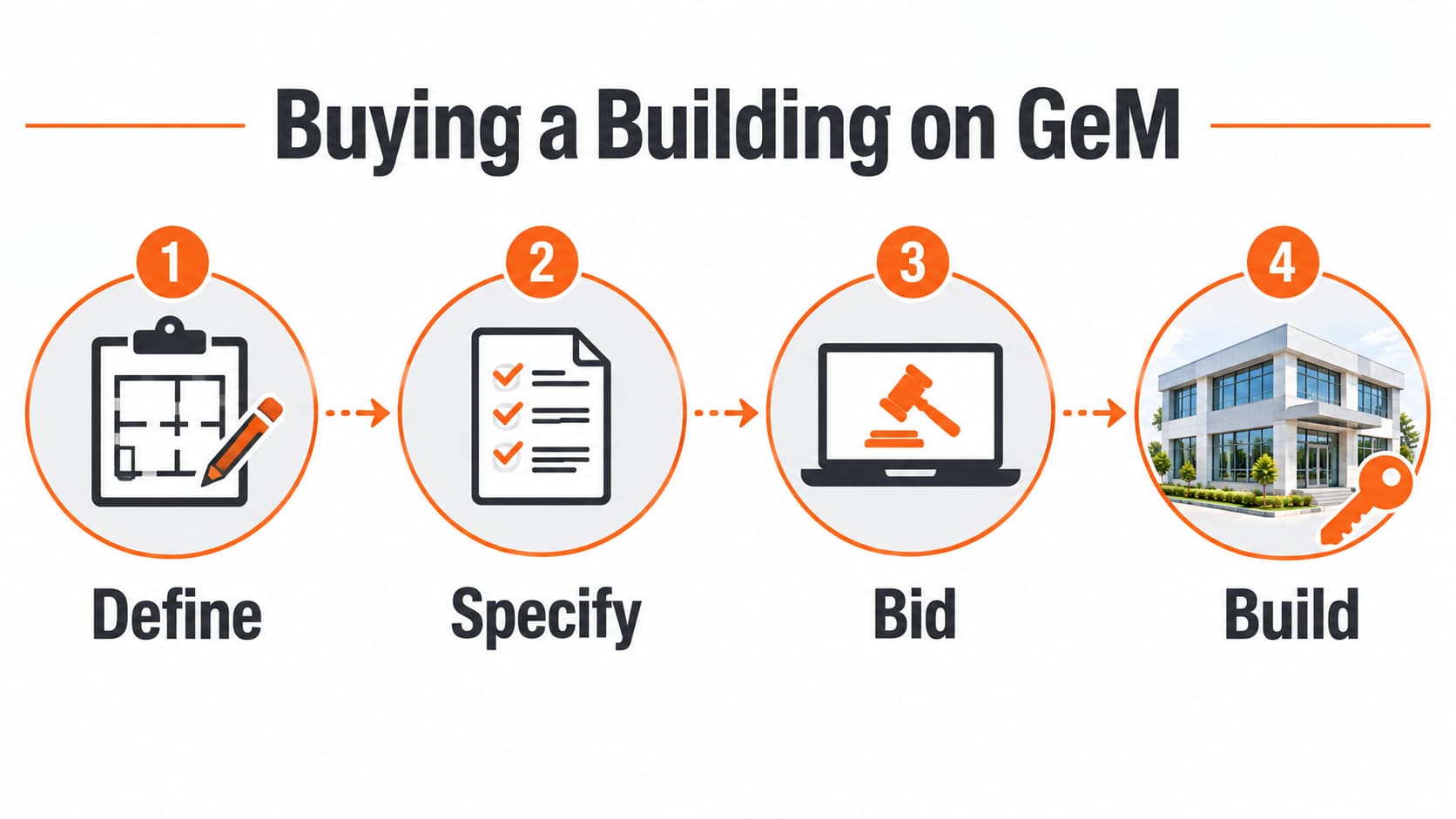
- Define the building: its use, a plan or sketch, built-up area, floors, any open-span requirement and the exact site.
- Choose the type: LGSF for rooms, steel structure for span, or both together.
- Search the catalogue: look for the LGSF category, a prefab hut or anything else that fits.
- Pick the route: catalogue, custom bid with an availability report, or BOQ bid.
- Write the specification using the checklist below.
- Set eligibility criteria: manufacturing capability, similar past work and technical compliance.
- Publish, then evaluate: check technical compliance first, and only then compare prices.
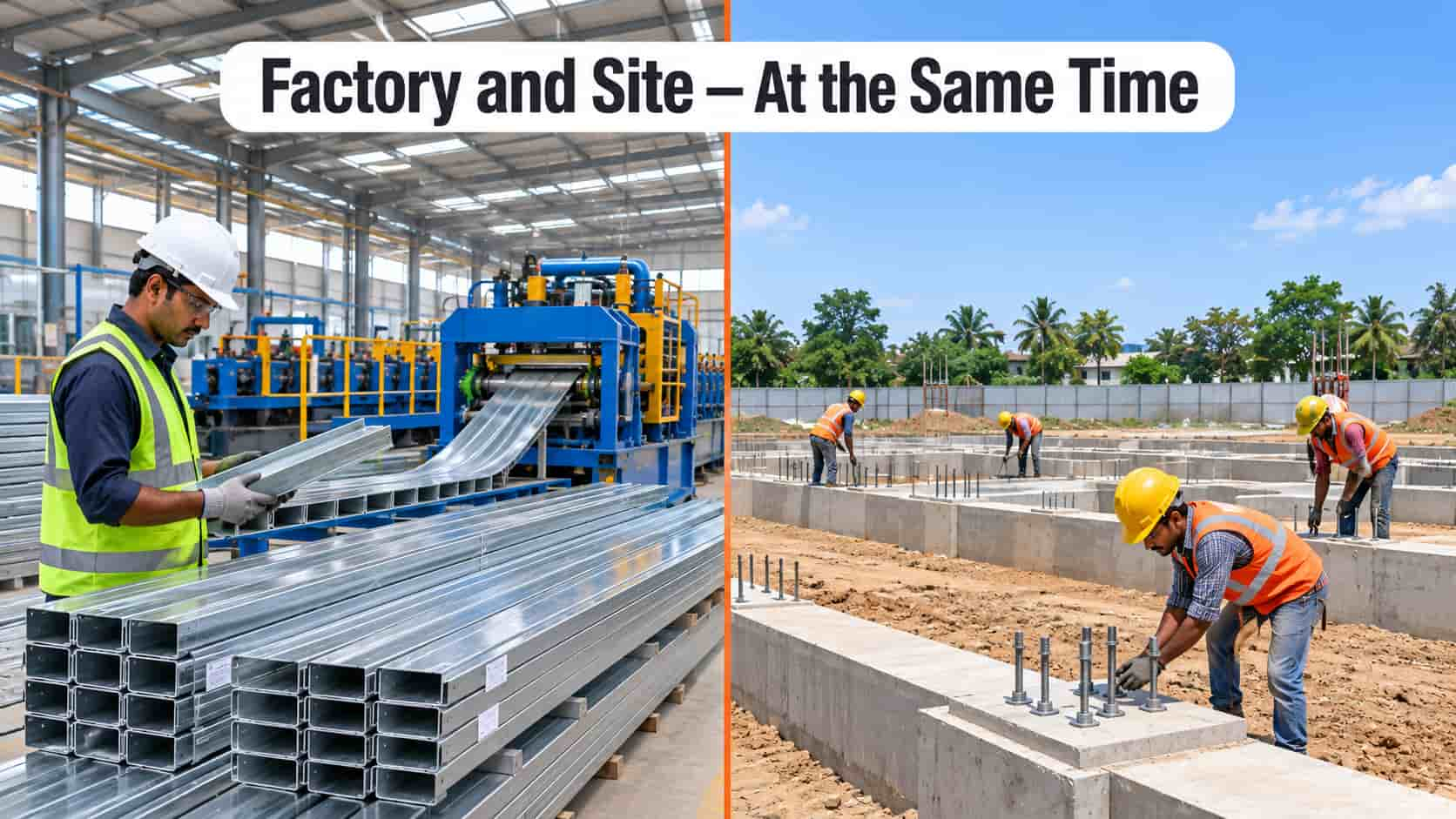
- Award, approve the design, build: the foundation goes in on site while the steel is made in the factory, then the building is erected and handed over.
Writing a Specification That Works
A good specification does two jobs. It makes sure you get a building that suits its use, and it makes the bids comparable. Describe performance, not one company's product.
| Cover this | What to write | Why it matters |
|---|---|---|
| Use and layout | Plan or sketch, room list, how the building will be used | Use drives floor loads, fire safety and finishes |
| Size | Built-up area, floors, clear heights, any open span | Tells bidders whether LGSF or a steel structure is needed |
| Site | Exact location, wind speed, seismic zone, soil data if you have it | The design must suit your site, not a generic one |
| Special loads | Crane, mezzanine, heavy racking, roof equipment, eave height | These change the frame size and the cost considerably |
| Walls and roof | Boards or cladding, insulation, roofing, fire rating | Comfort and fire performance come from these layers |
| Steel | Thickness range, strength and zinc coating weight, in writing | The details most often cut to win on price |
| Scope | Design, drawings, supply, erection, finishing, electrical, plumbing — each marked in or out | Stops a second bill arriving after award |
| Foundation | Who designs it and who builds it | The most common source of delay and dispute |
| Documents | Structural design, stability report, drawings for sanction, test reports | You will need them for approvals and audit |
| Time and warranty | Design approval period, erection period, warranty years | Gives you a schedule you can enforce |
Evaluating Bids
On GeM the lowest compliant bid normally wins, which means your eligibility criteria do most of the quality control. Four criteria matter most for a steel building:
- Manufacturing: does the bidder make the steel frame, or buy it from someone else? A manufacturer controls quality and dates. Our guide on how to choose an LGSF manufacturer explains what to check.
- Past work: completed government or institutional buildings of similar type and size, backed by completion certificates.
- Technical compliance: a point-by-point statement against your specification, with steel thickness, strength and coating spelled out.
- Turnover and experience: as your rules require. Eligible MSEs and startups can seek exemption by uploading supporting documents.
Two policies also affect the result. Under the MSE policy, micro and small manufacturers do not pay earnest money (traders do), and an MSE within 15% of the lowest price can be offered the chance to match it. Under Make in India, a supplier with more than 50% local content is a Class-I local supplier and gets purchase preference; above 20% is Class-II. A steel building fabricated in India will usually qualify as Class-I, which the supplier confirms with a local content certificate.
Mistakes That Delay Government Building Projects
| Mistake | What it causes | The fix |
|---|---|---|
| Specifying LGSF for a wide hall or shed | The design fails on span and has to be redone | Use a steel structure wherever you need open space |
| Copying catalogue values without checking the site | Wrong wind speed or seismic zone | Enter your site's actual values |
| Leaving the foundation unclear | The supplier waits for a foundation nobody has started | Name who designs it, who builds it and by when |
| Forgetting services | A building handed over without wiring or plumbing | Mark every scope item in or out |
| A very short bid period | Few bids, or rushed ones | Allow at least 21 days for a building |
| Not describing site access | Trucks that cannot reach the plot | Mention road width, distance and restrictions |
| Judging on price alone | A building that complies on paper only | Set firm technical and experience criteria |
How Long It Really Takes
The steel is rarely the slow part. Bid periods, committee meetings, design approval and the foundation usually set the pace. What saves time is that fabrication happens in the factory while the foundation is being built on site, and nothing in a steel frame needs to cure.
Once the foundation is ready, a typical LGSF building is structurally complete in 4 to 8 weeks and fully finished in 8 to 16 weeks. A steel structure frame usually goes up in a matter of weeks, with the total depending on span, cladding and finishes. That is why departments that move quickly on the bid often see the building finished within the same financial year it was sanctioned.
How We Can Help
Jadro Steel LLP designs, manufactures and erects both LGSF buildings and steel structure buildings from our own factory at Panchla, Howrah, and delivers across West Bengal, Bihar, Jharkhand, Odisha and the Northeast. For government clients, every offer comes with a site-specific structural design, drawings suitable for sanction, a stability report, and the steel thickness, strength and coating stated in writing.
Our government and institutional work includes steel structure fire stations at Agartala, Tripura and Gaya airport, Bihar, and an LGSF quarantine centre in Bhutan. If you are planning anganwadis, schools or health centres, see LGSF for government and institutional buildings. For halls and fire stations, see commercial steel buildings; for godowns and stores, our factory sheds and warehouses page.
Get technical support before you publish your bid
Share the building's use, plan, built-up area, floors and location. Our engineers will suggest the right type of steel building and the parameters worth specifying, and send a budget estimate for your proposal. The specification stays entirely yours.
Request technical support → · Call +91 98303 37549 · sales@jadrosteel.com
Questions Buyers Ask Us
Is an LGSF building a steel building?
Yes. LGSF is one type of steel building, made from thin cold-formed galvanised steel. The other main type is a steel structure building with a heavier frame of columns and beams. On GeM and in your specification, it helps to name the type you need.
Can we buy a porta cabin or site office on GeM?
Small prefab huts and cabins are usually listed as catalogue items, so search the portal first. Larger site offices, labour camps or multi-room buildings normally go through the LGSF category or a custom bid.
What exactly is a GeM Availability Report?
It is a report you generate on GeM to record that the item you need is not in the catalogue. You must have it before publishing a custom bid.
Can the supplier build the foundation as well?
In the LGSF catalogue category, the foundation is the buyer's job. In a custom or BOQ bid you can include it in the supplier's scope, which gives you a single point of responsibility.
Is a steel building suitable for high seismic zones like the Northeast?
Yes, provided it is designed for the site. Steel buildings are lighter than concrete ones, so they attract smaller earthquake forces, and the GeM LGSF category itself lets buyers specify the site's seismic zone. Ask bidders to show the seismic zone they designed for.
Do we need our own structural consultant?
For a BOQ bid, yes — someone has to prepare the drawings and quantities. For a custom bid or the LGSF category, the supplier designs the structure, but you should still have the design and stability report reviewed as your rules require.
What should the supplier hand over at completion?
As-built drawings, the structural design and stability report, test reports for materials, the warranty certificate and any operation or maintenance notes. List these in your bid so they are part of the contract.
Please note
This article is general information written by a supplier. It is not legal, financial or procurement advice. It reflects information publicly available on the GeM portal and in government orders as of 23 November 2026. Rules, financial limits, GeM categories and their terms change from time to time, and ministries, departments and states may follow their own procedures.
Before making any procurement decision, please confirm the current position on gem.gov.in and with your organisation's procurement or finance department. Timelines and other figures here are indicative and depend on the design, site and scope of each project.
Jadro Steel LLP is not affiliated with GeM or any government body. We take care to keep this article accurate, but we accept no liability for decisions or actions taken on the basis of it. Any offer, scope or commitment from us applies only when stated in a written quotation or contract.