
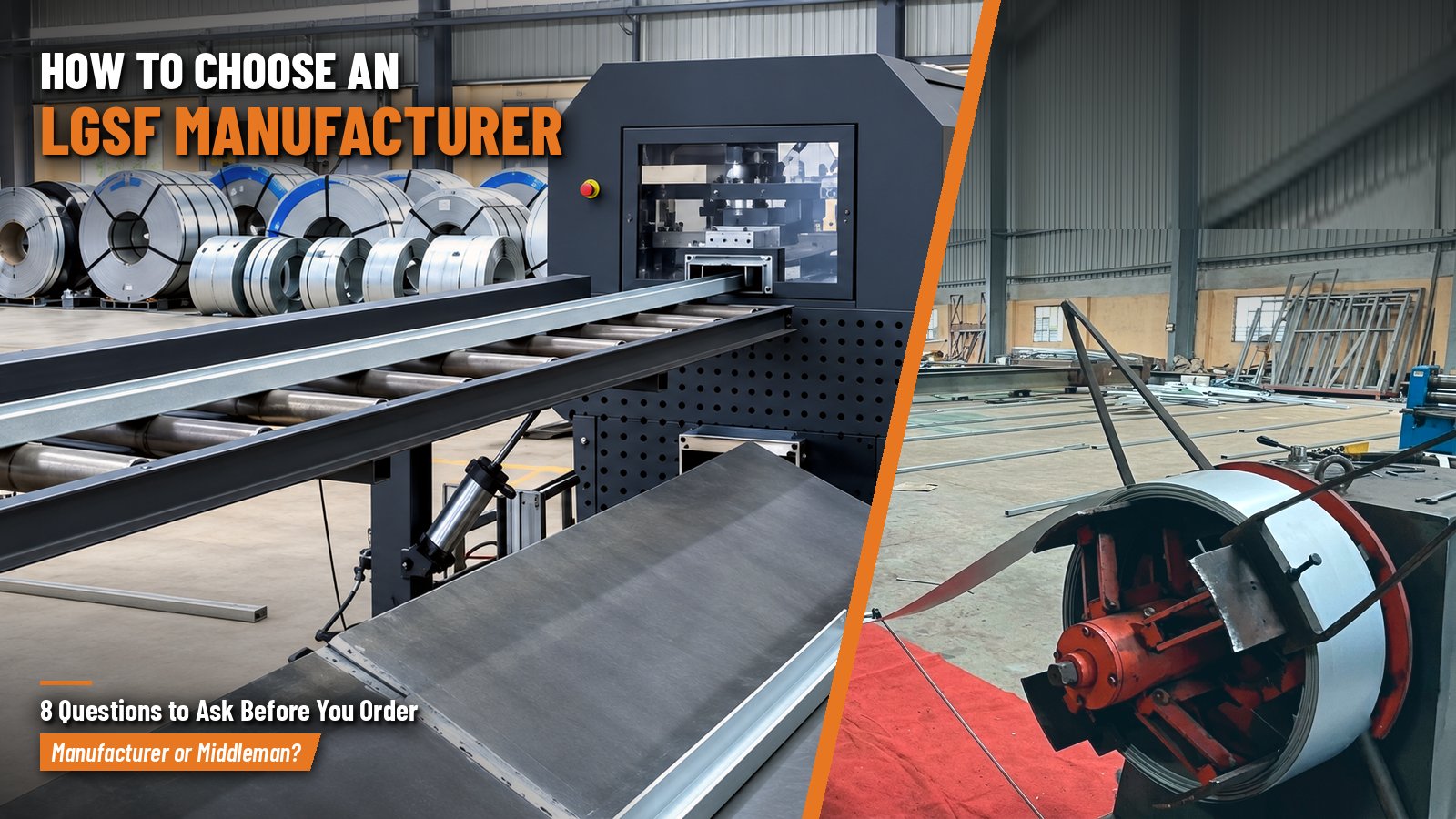
How to Choose an LGSF Manufacturer in India
Most people comparing LGSF suppliers are comparing the wrong things. They line up three quotations, look at the bottom line, and pick the middle one. Six months later the difference shows up — in panels that do not line up, in a crew standing around working out what goes where, in a wall that needed a thermal upgrade nobody quoted for.
Light gauge steel framing is not a commodity. Two frames for the same building, both galvanised, both roll-formed, can differ in gauge, coating weight, tolerance, panel sizing and whether anyone actually engineered them for your site. None of that appears in a per-square-foot number.
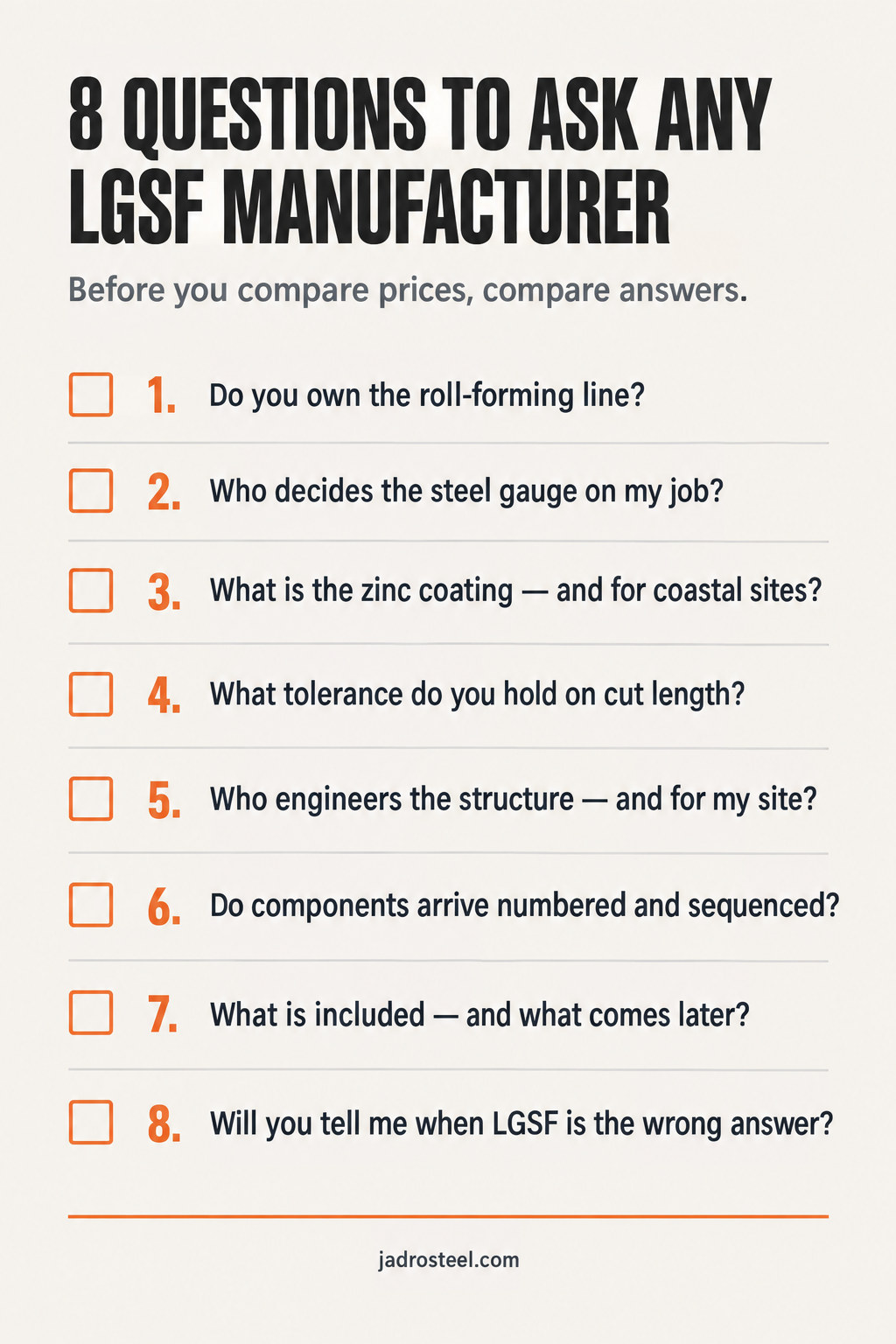
Here are the eight questions that separate a manufacturer from a middleman. Ask them of us, and ask them of everyone else you are talking to.
1. Do you own the roll-forming line, or do you buy the frame in?
This is the first question and it changes everything after it.
A large share of the companies presenting themselves as light gauge steel framing manufacturers do not roll steel. They take your drawing, place the order with someone who owns a line, and manage the delivery. There is nothing dishonest about that model — but it changes what they can promise you.
A reseller cannot commit to a fabrication date, because the date is not theirs. They cannot change a panel mid-run when your architect revises a window. And when a section arrives wrong, the correction goes through two companies instead of one.
Ask directly: where is the line, can I visit it, and is it yours?
A manufacturer will answer in one sentence. Watch what happens if the answer takes three.
2. What gauge do you roll, and who decides the gauge on my job?
Light gauge steel framing typically runs somewhere between 0.8 mm and 1.6 mm depending on what the structure carries. The number itself matters less than who chooses it.
If a supplier quotes you a single thickness for the whole building before seeing a drawing, they are working from a template. A ground-floor stud in a G+2 house carries a great deal more than a first-floor internal partition, and the frame should reflect that. A quotation that does not vary by position is a quotation that has not been engineered.
Ask what range they roll, and ask them to explain why your job gets the gauge it gets. The explanation tells you more than the number.
3. What is the zinc coating, and does it change for coastal sites?
The galvanized coating is what gives a steel frame a fifty-year life. It is measured in grams of zinc per square meter, and it is the specification most often quietly reduced to win a price comparison.
A frame going up in inland Jharkhand and a frame going up forty kilometers from the Bay of Bengal do not need the same coating. If a supplier offers the same specification everywhere, either they are over-specifying inland jobs or under-specifying coastal ones. Neither is a good sign.
Ask for the coating weight in writing, on the quotation, not in conversation. And ask what they would upgrade it to for a site in East Midnapore or the Sundarbans belt.
4. What tolerance do you hold, and how would I know if you missed it?
Every manufacturer will tell you their components are precise. The useful question is what happens when they are not.
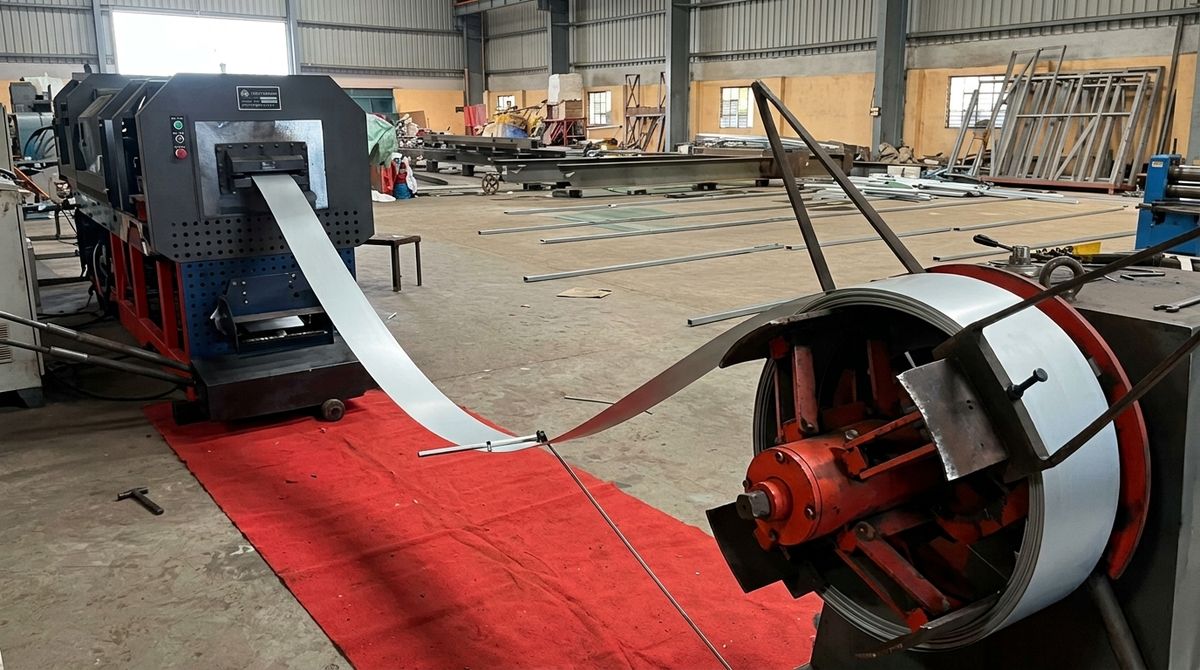
Tolerance on cut length is where factory production earns its premium over site fabrication. Held tightly, your interior contractor starts on a square shell. Held loosely, someone spends the first week of fit-out correcting somebody else's millimeters, and you pay for that week.
Ask what tolerance they hold, and then ask what the process is when a delivery does not meet it. A manufacturer who has thought about this has an answer. One who has not will tell you it does not happen.
5. Who does the structural engineering, and is it for my site?
This is where the real difference between LGSF construction companies in India sits, and it is almost never visible in a quotation.
Wind loading in coastal West Bengal is not wind loading in Ranchi. Seismic conditions in the Northeast are not seismic conditions in Odisha. A frame designed for one and shipped to the other is a frame that has been approximated.
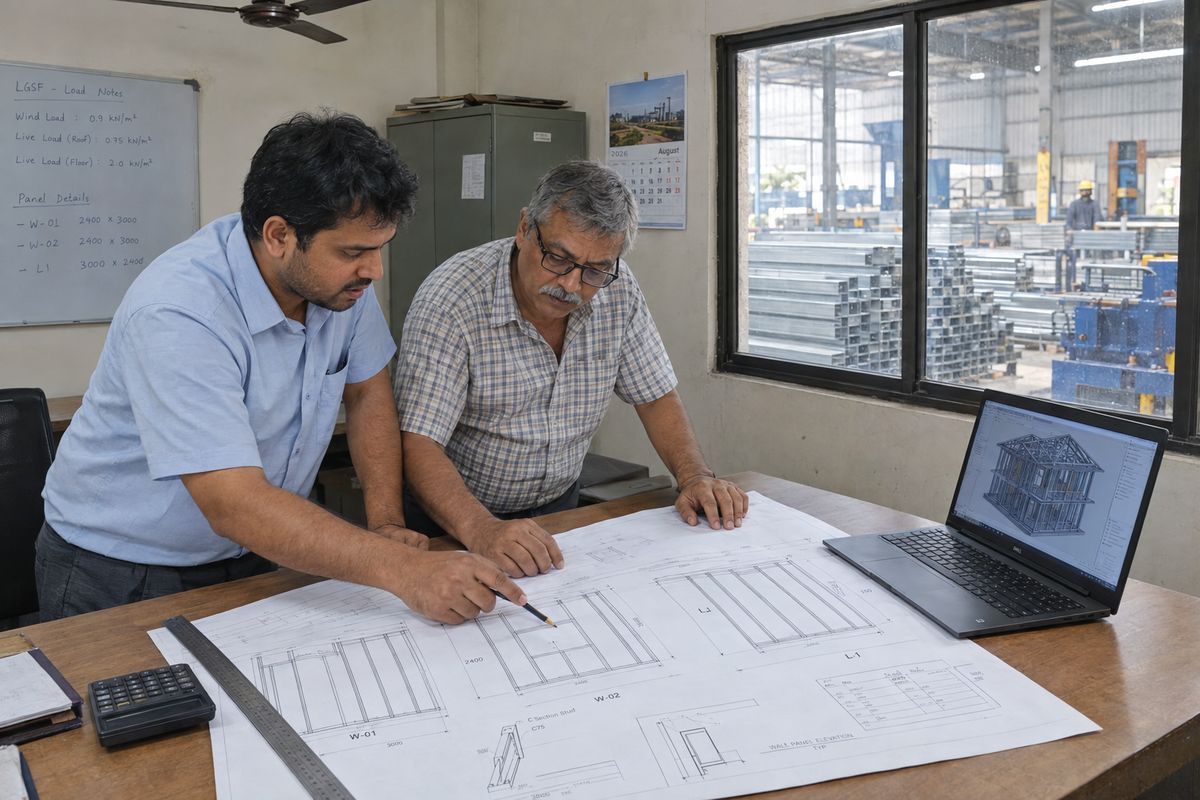
Ask whether the design is done in-house or bought in, ask to see a sample calculation set, and ask specifically what site data they used. If the answer is that they use a standard design for a standard size, you are buying a template with your address on it.
You should also ask who carries the structural liability. The answer should be a name, not a shrug.
6. Do components arrive numbered and sequenced?
A steel frame arrives as several hundred pieces. Whether those pieces are labelled and stacked in erection order, or tipped off a truck in a heap, is the difference between a crew assembling a building and a crew running a sorting exercise in the sun.
This costs the manufacturer time at their end. That is exactly why some skip it, and why the ones who do it will tell you about it without being asked.
Ask to see a photograph of a previous dispatch. Not a render — a photograph.
7. What is included, and what will I be asked for later?
The most common complaint about prefab quotations is not the number. It is the second number that arrives afterwards.
Get the scope in writing, line by line. Structural design. Drawings for sanction. The frame itself. Freight. Erection supervision. Erection labour. Insulation. Boarding. Cladding. Roofing. Each one is either in or out, and a quotation that does not say which is not a quotation.
Cost varies far more with finish level than with the frame itself — we have written separately about what LGSF actually costs and where the money genuinely goes. But scope clarity is what stops a comparison between two suppliers from being meaningless.
8. Will you tell me when LGSF is the wrong answer?
The last question is the one that reveals the most.
Light gauge steel framing suits a great deal — prefab house construction, showrooms, site offices and rooftop additions, buildings up to a few storeys. It does not suit everything. Very heavy point loads, very tall buildings, sites where a truck cannot reach the plot. Those jobs need a different system, and sometimes a different supplier.
A manufacturer who has never once told a customer "this is not for you" is a manufacturer who is selling, not advising. Ask them to describe a project they turned down. The answer, or the absence of one, is informative.
Red flags worth naming
A per-square-foot rate quoted before anyone has seen your drawing. The frame has not been engineered; the number has been guessed.
No factory address, or a factory address that turns out to be an office.
The same specification for every site regardless of location.
Photographs of completed buildings that appear on three other websites.
Reluctance to put coating weight, gauge and tolerance on the quotation.
A timeline with no design and approval stage in it. That stage exists whether
or not it appears on the schedule.
How to run the comparison
Send the same drawing and the same brief to three LGSF suppliers in India. Ask each of them these eight questions in writing.
Then compare the answers, not the totals. You will usually find the quotations are closer than you expected and the answers are not close at all.
If you are still deciding between systems rather than suppliers, we have written about which steel building system suits your project and how LGSF compares with brick and RCC.
Where we stand on these eight
We roll every section ourselves on our roll-forming line in Howrah. Nothing about the frame is subcontracted. Every job is engineered for its own site before it is quoted, and the coating specification changes for coastal districts. Components leave numbered and sequenced in erection order.
And we have turned work down — projects where the span, the loading or the site access made a heavier frame the honest answer.
Send us a drawing, or just a plot size and a location, and ask us the eight questions. If our answers do not satisfy you, ask them of somebody else. That is the point of the list.
LGSF Manufacturer in India: Frequently Asked Questions :
Q: How do I know if an LGSF manufacturer actually owns a factory?
A: Ask to visit. A manufacturer will name a location and a time. If a visit is deflected twice, you are probably talking to a trading company. You can also ask for a photograph of the roll-forming line with their own material running through it.
Q: What gauge of steel should my LGSF building use?
A: It depends on what the frame carries, and it should vary within the same building. Ground-floor studs in a multi-storey house carry far more than upper-floor partitions. Any supplier quoting one thickness for the whole job has not engineered it.
Q: Does the zinc coating need to be different near the coast?
A: Yes. Humidity and salt exposure shorten the working life of a lighter coating, so coastal and high-humidity districts should be specified with a heavier one. Ask for the coating weight in writing on the quotation.
Q: Are all LGSF manufacturers in India the same on quality?
A: No, and the differences are mostly invisible in a quotation — gauge selection, coating weight, dimensional tolerance, whether the structure was engineered for your site, and whether components arrive labelled. Those five things separate suppliers far more than the headline rate does.
Q: Should I choose the cheapest LGSF quotation?
A: Only after confirming the three quotations cover the same scope. Most prefab price comparisons are meaningless because one is structure-only and another is turnkey. Get the scope written line by line first, then compare.