
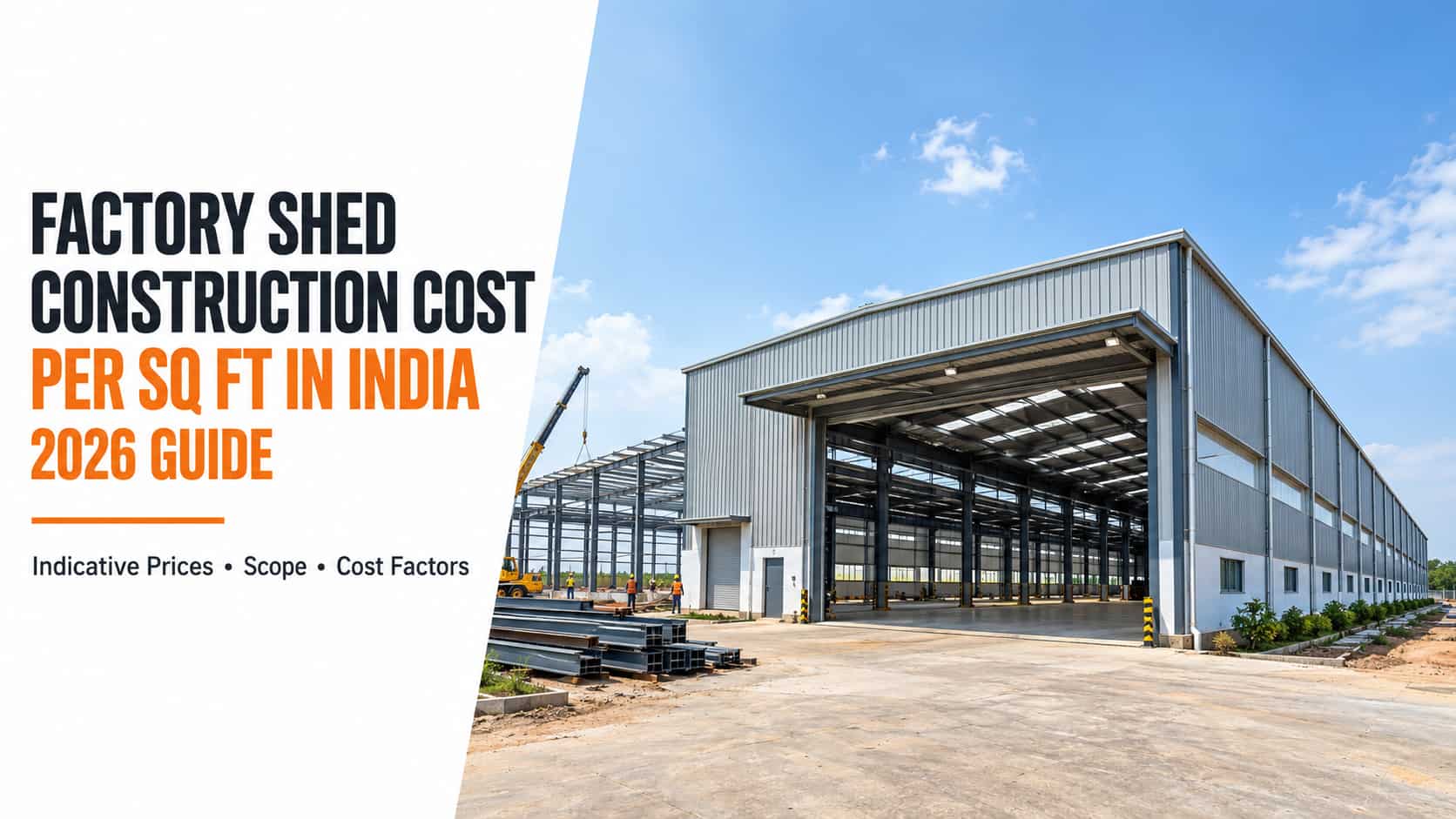
Factory Shed Construction Cost per Sq Ft in India (2026 Guide)
Planning a factory shed starts with one question: how much will it cost? The honest answer is that it depends on what you are building, where, and what you include. Two sheds of the same size can differ in cost by more than double.
This guide gives you indicative 2026 cost ranges, explains what is included at each level, and walks through every factor that moves the final price. That way you can budget realistically and compare quotations on equal terms.
Please note: All prices in this guide are indicative ranges for budgeting and comparison only. They are not a quotation or an offer. Actual project cost is fixed only after site details, design requirements and the scope of work are confirmed.
Indicative Factory Shed Cost per Sq Ft (2026)
| Scope of work | What is typically included | Indicative cost per sq ft |
|---|---|---|
| Structure + sheeting | Steel frame, purlins, roof and wall sheeting, gutters, erection | ₹450 – ₹750 |
| Shell | Above + foundations, plinth, basic floor, rolling shutters | ₹800 – ₹1,300 |
| Turnkey (standard) | Shell + industrial flooring, brick dado wall, skylights, ventilators, drainage, basic electrical | ₹1,300 – ₹2,000 |
| Heavy industrial | Turnkey + crane provision, higher eave height, insulated panels, mezzanine floor | ₹2,000 – ₹2,800 and above |
These ranges assume:
- A shed of roughly 10,000 sq ft or larger
- A standard clear span of 20–30 m and an eave height of 6–8 m
- Normal soil and good road access
- Steel prices as of 2026
- GST, land development and statutory approvals extra
If your project falls outside these assumptions, your cost will be different. The sections below explain how.
Why Your Final Quotation May Differ From These Ranges
A per-sq-ft figure is a starting point for budgeting, not a fixed price. A quotation for your project is prepared only after studying your exact requirements, so it can come out higher or lower than any published range. These are the most common reasons.
1. Steel prices change
Steel is the largest single cost in a factory shed, and its market price moves month to month. A quotation reflects steel rates on the date it is prepared. That is also why quotations carry a validity period.
2. Your design needs more steel
A wider span, taller columns, a crane, a mezzanine or higher wind exposure all increase the steel weight. Two 10,000 sq ft sheds can use very different amounts of steel.
3. Smaller sheds cost more per sq ft
Fixed costs like design, mobilisation, transport and crane hire are spread over fewer square feet. A 3,000 sq ft shed will usually cost more per sq ft than a 30,000 sq ft shed.
4. Site conditions
Soft or filled soil needs deeper foundations. Sloping land needs levelling. Narrow access roads may need smaller trucks and extra trips. Remote and hilly locations, including many parts of the Northeast, add transport and lifting costs.
5. Scope added after the budget stage
Better flooring, insulated roofing, office cabins, extra doors, fire safety items and electrical upgrades are often decided later. Each one adds to the final figure.
6. Specifications you choose
Sheet thickness and coating, paint system, type of ventilators, and brand of accessories all affect cost. A quotation is priced on the exact specification you approve.
The right way to use this guide: take the range that matches your scope as a rough budget, then get a detailed quotation that lists every item, so you can see exactly what you are paying for.
What Drives the Cost of a Factory Shed
Clear span (column-free width)
Wider spans need deeper, heavier rafters. Spans of around 20–25 m are usually the most economical. Beyond 30–35 m without internal columns, steel weight rises noticeably. If your process allows a row of internal columns, a multi-span shed often costs less.
Eave height
Taller columns carry more wind load and use more steel. Warehouses with high racking, and sheds with overhead cranes, need more height and cost more as a result.
Crane load
An overhead crane needs crane girders, brackets and stronger columns and foundations. If you may add a crane in future, plan the provision at the design stage. Strengthening an existing shed later is far more expensive and disruptive.
Roof and wall cladding
Colour-coated metal sheets are the most economical option. Insulated sandwich panels cost more but keep the interior cooler, which matters for food processing, pharma, electronics and cold storage. Many sheds use a brick wall up to 3 m with sheeting above, as a balance of cost and durability.
Flooring
Flooring is the most commonly underestimated item. A warehouse with hand trolleys needs a simple floor. A factory with forklifts, heavy machines or racking needs a properly designed industrial floor, which can add significantly to the cost per sq ft.
Foundations and soil
The steel structure is only as good as the foundation under it. A soil test tells you the bearing capacity. Weak soil means larger or deeper footings, and sometimes piles.
Location
Distance from the fabrication facility, road quality, local labour availability and weather windows all affect cost and schedule.
Conventional Steel vs Pre-Engineered vs Steel Structure Building
| Feature | Conventional hot-rolled steel | Pre-engineered steel building | Steel structure building (pre-engineered frame + light gauge steel walls and roof) |
|---|---|---|---|
| Best suited for | Small sheds, irregular layouts | Large-span factories and warehouses | Factories with attached offices, site buildings, mixed-use sheds |
| Steel efficiency | Lower: uses standard rolled sections | Higher: members are tapered to match loads | Higher |
| Speed of construction | Moderate | Fast | Fast; interiors finish quicker than brick |
| Future extension | Possible, more site work | Easy to extend along the length | Easy to extend |
| Indicative cost (structure + sheeting) | ₹500 – ₹800/sq ft | ₹450 – ₹750/sq ft | ₹550 – ₹850/sq ft |
For most factories above 10,000 sq ft, a pre-engineered frame gives the best cost per sq ft because steel is placed only where the loads need it. Where the shed includes office space, labs, canteens or staff rooms, a steel structure building pairs the large-span frame with light gauge steel walls, which go up faster and are easier to finish than masonry.
Indicative Cost by Type of Shed
| Shed type | Typical position in the range | Why |
|---|---|---|
| Warehouse / godown | Lower end | Simple layout, lighter floor loads |
| Light manufacturing / assembly | Middle | Better flooring, ventilation and lighting |
| Heavy engineering / fabrication shop | Upper end | Crane loads, heavy floors, taller columns |
| Cold storage / food processing | Upper end | Insulated panels, hygienic finishes |
Items That Are Often Quoted Separately
When comparing quotations, check whether each of these is included or excluded:
- Soil testing
- Structural design and drawings
- Foundations and plinth
- Transport to site and crane hire
- Industrial flooring
- Electrical, lighting and earthing
- Fire safety provisions
- Rainwater drainage and site levelling
- Statutory approvals
- GST
A quotation that looks much cheaper often simply excludes several of these. Comparing only the per-sq-ft figure without checking the scope can be misleading.
Why Prices Seen Online Vary So Widely
You may see factory shed prices online ranging from a few hundred rupees per sq ft to several thousand. The difference is almost always the scope. Very low figures usually cover fabricated steel supply alone, without design, foundations, sheeting or erection. Higher figures usually cover a complete, ready-to-use building. Compare figures only when they cover the same scope.
How to Get an Accurate Quotation
To get a quotation you can rely on, share these details:
- Plot size and planned shed footprint
- Required clear span and eave height
- Crane capacity (now or planned in future)
- How the shed will be used and the expected floor loads
- Wall type: full sheeting, brick dado with sheeting, or panels
- Any office, mezzanine or staff areas inside the shed
- Site location and access road condition
- Soil test report, if available
- Your target completion date
The more complete the information, the closer the quotation will match the final cost.
Planning a Factory Shed in Eastern or Northeast India?
Jadro Steel designs, manufactures and erects factory sheds and steel structure buildings across West Bengal, Bihar, Jharkhand, Odisha and the Northeast from our facility in Panchla, Howrah. Explore our industrial steel structures or share your requirements for a detailed, item-wise quotation.
Related reading: Types of Steel Buildings in India · LGSF House Construction Cost per Sq Ft
Frequently Asked Questions
What is the cost of a factory shed per sq ft in India in 2026?
As an indicative range, the steel structure with roof and wall sheeting costs about ₹450–₹750 per sq ft, a shell with foundations and basic floor about ₹800–₹1,300, and a standard turnkey shed about ₹1,300–₹2,000 per sq ft, before GST. Actual cost depends on design, site and scope.
Why is my quotation higher than the range I saw online?
Usually because of the design (wider span, more height, crane), the site (soil, access, location), a smaller shed size, current steel prices, or additional scope such as better flooring or insulation. A detailed quotation lists each item so you can see where the difference comes from.
How much does a 10,000 sq ft factory shed cost?
As a rough budget, a shell-level shed may fall around ₹80 lakh to ₹1.3 crore, and a standard turnkey shed around ₹1.3 crore to ₹2 crore, before GST. These are indicative only. A heavier specification or a difficult site can take the cost higher.
Is a pre-engineered steel shed cheaper than an RCC building?
For large spans, generally yes. A pre-engineered steel shed uses steel efficiently, is faster to build, and can be extended later. For very small structures the difference narrows.
How long does it take to build a factory shed?
It depends on size, design approval, civil work and site conditions. Fabrication can run alongside foundation work, which shortens the overall schedule compared with conventional construction.
Do these prices include GST?
No. All ranges in this guide are before GST.
Why does a quotation have a validity period?
Because steel and other material prices change. The validity period protects both the buyer and the manufacturer from sudden market movements.