
Steel Structural Design Basics: Loads, Codes & IS 800 Explained Simply
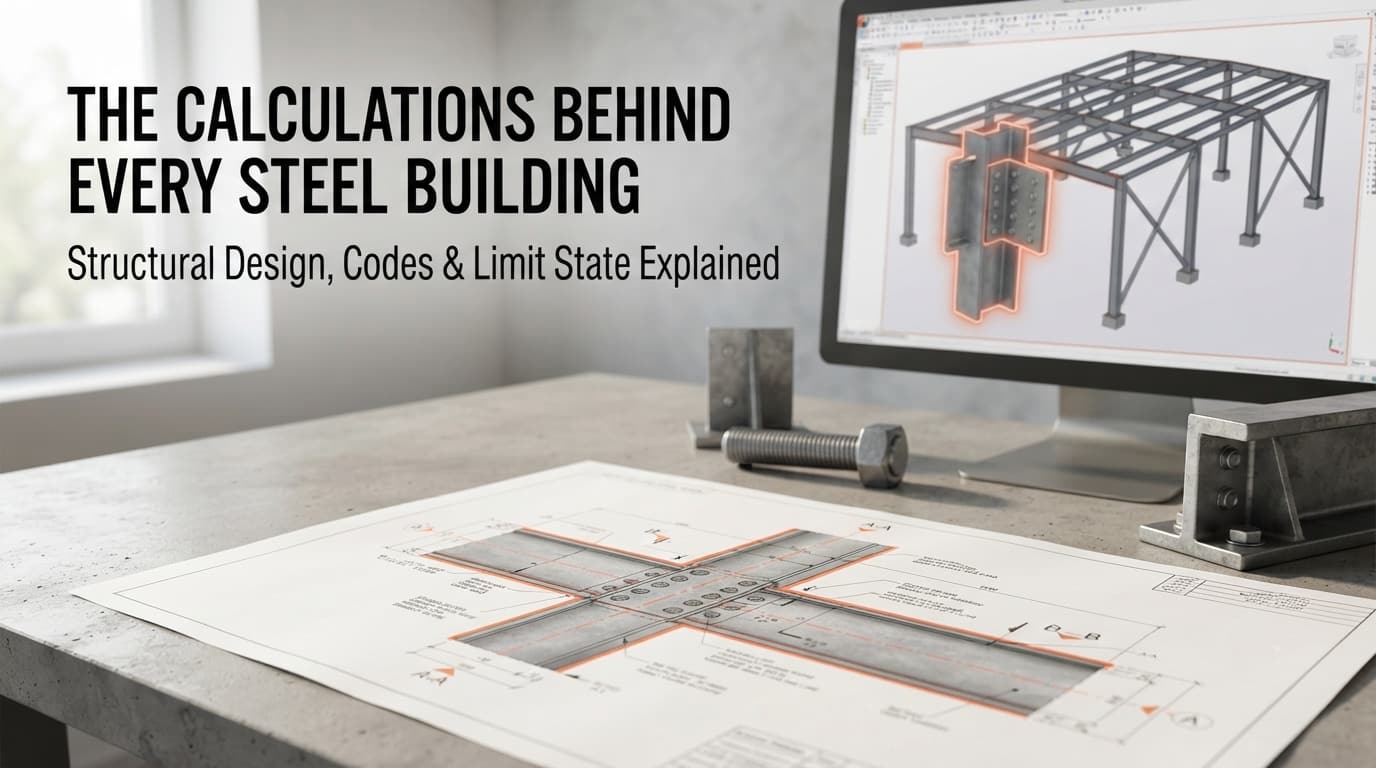
Every steel building, whether a warehouse, a hybrid commercial block, or an LGSF home, stands safely because of decisions made long before fabrication begins: decisions of structural design. Yet for most clients, architects, and even young site engineers, structural design remains a black box of software printouts and code references. This guide opens that box. In plain language, we explain what loads a structure must resist, which Indian codes govern steel design, what "limit state design" actually means, and how members and connections are chosen, so you can have informed conversations with your structural consultant and evaluate what you are buying.
What Does a Structural Designer Actually Do?
A structural designer answers three questions for every part of a building. First, what forces will this part experience over 50-plus years? Second, is the chosen member strong and stable enough to resist those forces with an adequate margin of safety? Third, will the building remain comfortable and serviceable: not deflecting, vibrating, or cracking in ways that alarm occupants? The design process converts architecture into a verified load path: a continuous chain through which every force travels from the roof, through beams and columns, into the foundation, and finally into the soil. A building fails only when this chain has a weak link, which is why design reviews obsess over connections and continuity, not just member sizes.
The Loads Every Steel Building Must Resist
Dead Load (IS 875 Part 1)
The permanent self-weight: steel members, floor slabs or boards, walls, roofing, finishes, and fixed services. Steel's great advantage is that its own dead load is low, which reduces everything downstream.
Live Load (IS 875 Part 2)
Loads from use and occupancy: people, furniture, storage, equipment. Codes prescribe minimum values: for example, residential floors around 2 kN/m², offices 2.5 to 4 kN/m², storage areas much higher. Choosing the correct occupancy category is a critical early decision.
Wind Load (IS 875 Part 3)
Wind pressure depends on the site's basic wind speed (coastal Bengal and cyclone-prone regions have high values), terrain, building height, and shape. Wind can push, pull (suction on roofs is often the governing case), and overturn. Light steel buildings must be explicitly anchored against uplift, which is why hold-down details matter so much.
Seismic Load (IS 1893)
Earthquake force is essentially mass times acceleration: the heavier the building and the more severe the zone (Northeast India is largely zone V, the highest), the larger the force. This is the deep reason light steel construction excels in seismic regions: halving the mass roughly halves the earthquake demand.
Other Loads
Temperature effects, erection loads, crane loads in industrial buildings, and load combinations in which several loads act together, are all specified by the codes. The structure is checked against the worst realistic combinations, not loads in isolation.
The Indian Code Framework for Steel Design
IS 800:2007 — The Mother Code
IS 800 is the general code for hot-rolled steel design in India. Its 2007 edition moved Indian practice to Limit State Design, aligning us with international standards. It covers tension and compression members, beams, beam-columns, connections (bolted and welded), fatigue, and fire considerations.
IS 875 (Parts 1 to 5) — Loads
The load code family described above: dead, live, wind, snow, and combinations.
IS 1893 — Earthquake Design
Defines seismic zones, response spectra, and how to compute earthquake forces, with ductile detailing philosophies that let structures absorb energy safely.
IS 801 and Cold-Formed Steel
Light gauge (cold-formed) members, the thin studs and tracks of LGSF, behave differently from hot-rolled sections: they can buckle locally in complex modes. IS 801 governs them in India, and designers commonly reference the more current international AISI S100 standard for advanced checks. This is why LGSF design demands specialised software and expertise; hot-rolled intuition does not transfer directly.
Supporting Codes
IS 2062 specifies structural steel material grades (E250, E350, etc.); IS 808 lists standard rolled section dimensions; welding and bolting have their own standards. Together these form a complete, legally recognised design ecosystem.
Limit State Design: The Core Philosophy Explained
Older design methods used a single "factor of safety." Limit State Design is smarter: it recognises two distinct ways a structure can fail its purpose.
The Ultimate Limit State asks: can the structure collapse? Loads are increased by partial safety factors (for example, 1.5 on many combinations) and material strengths are reduced by their own factors, and the member must still survive. This guards against rupture, buckling, and overturning with rationally distributed margins.
The Serviceability Limit State asks: is the building pleasant and functional under normal loads? Deflection limits (such as span/300 for beams supporting brittle finishes), vibration comfort, and sway limits for tall frames all live here. A beam can be "safe" yet fail serviceability by bouncing annoyingly: both checks are mandatory.
Members and What They Do
Columns carry compression down the building; their enemy is buckling, so their effective length and bracing matter as much as their area. Beams carry bending; designers check bending strength, shear, web crippling, and lateral-torsional buckling (a beam's tendency to twist sideways unless its compression flange is restrained). Bracing converts a floppy rectangle into a stiff triangle, giving the frame its resistance to wind and earthquake; removing "those diagonal members" during renovation is a classic and dangerous mistake. Purlins, girts, and studs are the secondary members that carry cladding loads to the main frame; in LGSF, cold-formed studs are the primary vertical members themselves, designed for combined axial load and bending.
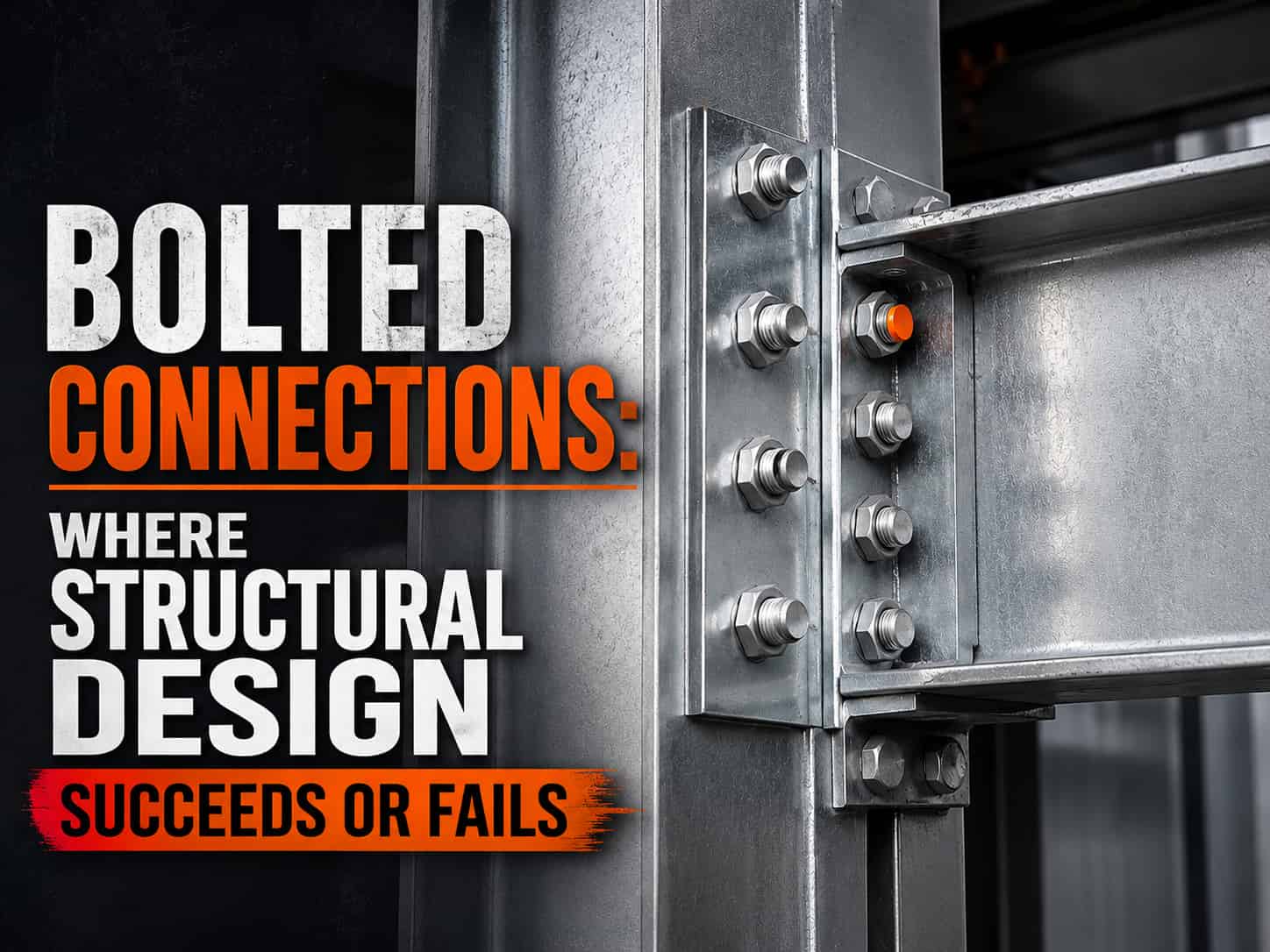
Connections: Where Design Succeeds or Fails
Most structural failures trace to connections, not members. Bolted connections dominate site work for speed and inspectability; welded connections dominate factory fabrication for stiffness and economy. Each connection is designed for the forces it must transfer: shear, tension, moment, and detailed so forces flow without tearing thin elements. In LGSF, connections are self-drilling screws in engineered patterns; a single wall panel may contain over 200 screws, each one specified by the design output, which is why "screws as per drawing" is a phrase worth respecting on site.
What Clients Should Ask Their Structural Designer
Which codes and load values were used, and what wind speed and seismic zone were assumed for my site? What are the deflection limits adopted? Are connection designs included in the deliverables, with drawings? For LGSF: what steel grade, thickness, and galvanizing coating does the design require, and does the fabricator's supply match it? A designer who answers these crisply is a designer you can trust.
Good structural design is invisible when done well: the building simply stands, decade after decade, through storms and tremors. At Jadro Steel LLP and Sanganeria Steel Construction Company, every project, from LGSF residences to hybrid commercial frames, is engineered to IS 800, IS 875, and IS 1893 with full connection detailing, because in structures, the calculations you never see are the product you are actually buying.
FAQ
Q1. What is IS 800 in simple terms?
IS 800:2007 is India's master code for designing hot-rolled steel structures, prescribing how to check members and connections for strength, stability, and serviceability using limit state design.
Q2. What is the difference between IS 800 and IS 801?
IS 800 governs hot-rolled steel sections; IS 801 governs cold-formed light gauge steel (like LGSF studs), whose thin walls have different buckling behaviour requiring separate design rules.
Q3. What is limit state design?
A design philosophy that separately ensures the structure cannot collapse under factored extreme loads (ultimate limit state) and remains comfortable and functional under everyday loads (serviceability limit state).
Q4. Which seismic zone is Kolkata and the Northeast in?
Kolkata lies in seismic zone III to IV depending on location; most of Northeast India is in zone V, the most severe, making lightweight steel construction especially advantageous there.
Q5. What steel grades are used in Indian construction?
Hot-rolled structures commonly use IS 2062 grades E250 to E450; LGSF uses high-tensile galvanized coils, typically 350 to 550 MPa yield strength with Z120 to Z275 zinc coating.
Q6. Why do connections matter so much in steel design?
Forces must transfer between members through connections; most real-world failures occur at poorly designed or poorly executed joints, so connection drawings deserve as much attention as member sizes.